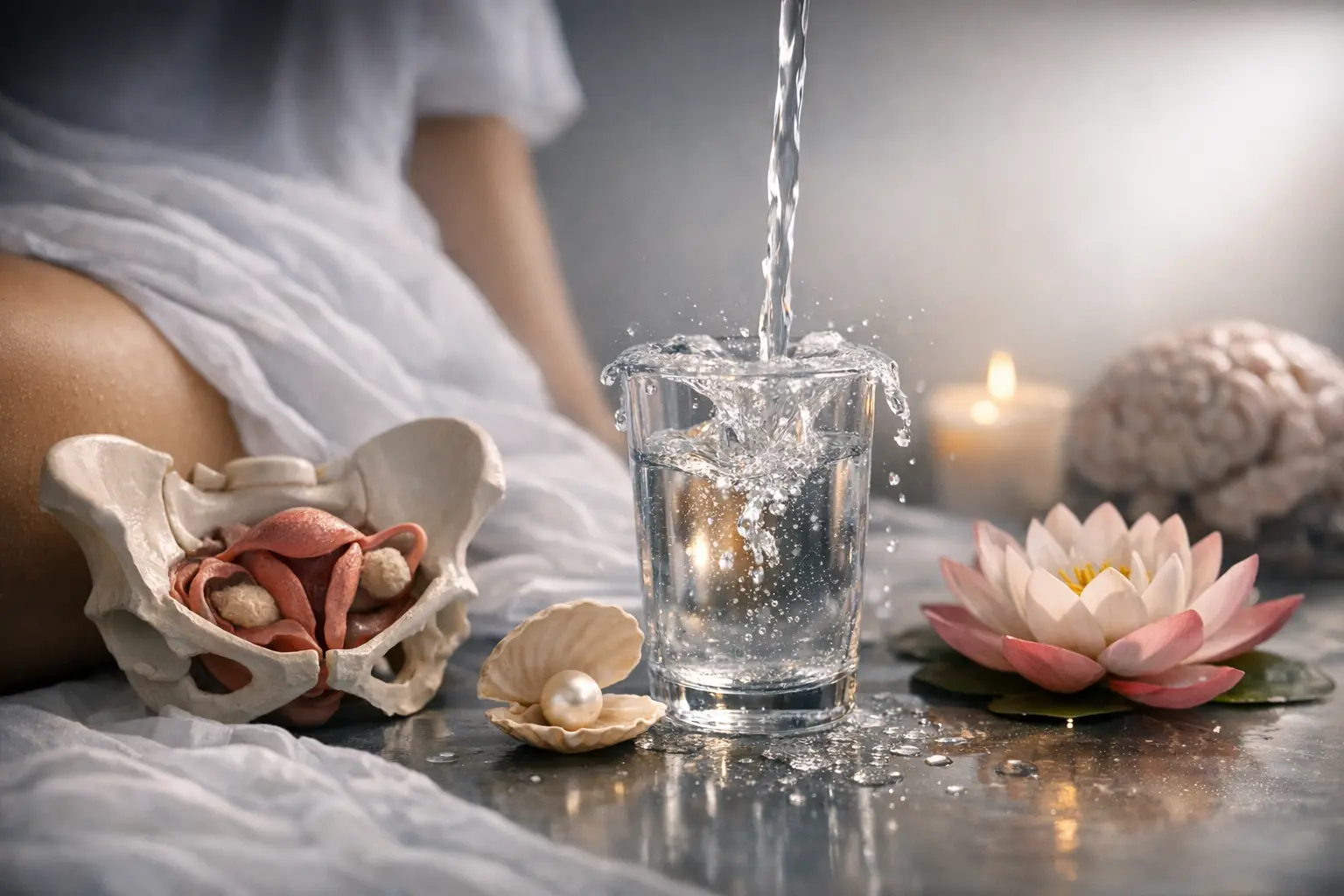
Female ejaculation is real, but it’s also widely misunderstood—often confused with lubrication, portrayed as rare or “porn-only,” or treated like a performance benchmark. If you’ve ever wondered how common it actually is, what’s happening biologically, and why some people experience it while others don’t, this guide breaks it down with clear science, practical insight, and a grounded view of sexual diversity.
The Biological Mechanisms Behind Female Ejaculation
To understand how common female ejaculation is, you first need a clean definition. In everyday conversation, people use “female ejaculation” to mean any fluid released during intense arousal or orgasm. In a clinical sense, there are two related but distinct phenomena:
1) Female ejaculation (FE): the release of a small-to-moderate amount of fluid from the urethra, often milky or clear, associated with “Skene’s glands” (sometimes described as the female prostate).
2) Squirting (sometimes called “female orgasmic fluid”): the expulsion of a larger volume of mostly dilute fluid, also from the urethra, that tends to be more watery. This can occur with or without orgasm.
Why does the distinction matter? Because when people ask “Is female ejaculation common?” they may be picturing dramatic squirting scenes, when the more biologically typical ejaculation-like release can be subtler. Without clear definitions, prevalence estimates swing wildly.
Skene’s glands and the urethral sponge. The Skene’s glands sit near the urethra and can contribute fluid during sexual stimulation. They are embedded in tissue sometimes called the “urethral sponge,” which swells with arousal. This region is part of what many people refer to as “G-spot” anatomy, though experts increasingly frame it as a complex of tissues (urethra, sponge, clitoral structures, vaginal wall) rather than a single spot.
Where the fluid comes from. During arousal, pelvic blood flow increases, tissues engorge, and glandular secretions rise. In some people, the Skene’s glands produce fluid that can be expelled through the urethra with orgasmic contractions or intense stimulation. In squirting, research-based reasoning suggests that the bladder can fill rapidly during arousal, and the expulsed fluid is often primarily urine diluted with other secretions. That doesn’t mean it’s “just peeing” in the simplistic, shaming way the internet sometimes frames it; it reflects a real arousal response in which the bladder, urethra, and surrounding tissues participate.
But why does it happen for some and not others? Several variables influence whether ejaculation/squirting is noticed:
Anatomy and gland size: Skene’s glands vary in size and sensitivity. Some people may produce more secretions; others may produce little to none, or the fluid may travel backward into the bladder.
Nerve sensitivity and arousal pattern: Some bodies respond more strongly to internal stimulation along the anterior vaginal wall; others respond primarily to external clitoral stimulation. Both pathways are normal, but different patterns may influence urethral-sponge involvement.
Pelvic floor dynamics: Rhythmic contraction and relaxation patterns can affect whether fluid is expressed outward, retained, or not produced in noticeable volume.
Hydration and bladder fullness: A more full bladder can increase the likelihood of larger-volume expulsions, even when the experience is orgasmic and pleasurable.
One practical takeaway is this: female ejaculation isn’t a “switch” that only certain people have. It’s an intersection of anatomy, arousal, stimulation, and comfort. That sets the stage for the prevalence question, where myths and measurement challenges are the main reason people get conflicting answers.
Prevalence and Myths Surrounding Female Ejaculation
So, how common is female ejaculation? The most honest expert answer is: it depends on how you define it, and how you measure it. In self-report surveys, rates differ dramatically because many participants aren’t sure what counts. Some people mistake normal vaginal lubrication for ejaculation; others have experienced urethral fluid release but assumed it was accidental urination and never reported it.
General prevalence ranges. Across various surveys and clinical discussions, the portion of people who report ever experiencing some form of ejaculation/squirting tends to fall somewhere from “a minority” to “a substantial minority”—often cited broadly in the ballpark of 10% to 50% depending on the definition and the population sampled. That range isn’t an evasion; it reflects genuinely inconsistent classification.
If you separate the phenomena, a clearer picture emerges:
Subtle female ejaculation (small-volume fluid): likely more common than many think, but frequently unnoticed. A small release can mix with lubrication and be absorbed by bedding or wiped away without obvious “evidence.”
Large-volume squirting: likely less common than pornography implies. Many people may never experience high-volume release, and that is entirely normal.
Why porn distorts expectations. In adult content, squirting is often presented as a reliable marker of “maximal orgasm.” That’s not grounded in sexual physiology. Orgasm intensity doesn’t reliably correlate with fluid volume. Some people have strong orgasms without any expulsion; others may expel fluid without orgasm; others may do both.
Common myths that keep the topic confusing:
Myth: “If you don’t ejaculate, you’re missing the best kind of orgasm.”
Reality: There is no single “best” response. The nervous system, pelvic floor, and emotional context shape orgasm more than any one sign.
Myth: “Squirting is always urine, therefore it’s not real sexual response.”
Reality: Even when fluid is largely urinary in composition, the event can still be an arousal-linked reflex involving periurethral tissues. Reducing it to “you peed” often functions as shame, not science.
Myth: “Ejaculation is rare; only a few women can do it.”
Reality: The potential for urethral fluid release appears to be present in many bodies, but it may not occur spontaneously, may not be sought, or may not be recognized.
Myth: “You can train anyone to squirt if you do the right technique.”
Reality: Technique matters, but so do anatomy, comfort, and desire. Some people will never squirt, and that’s normal. A partner “trying to make it happen” can also create exactly the kind of pressure that shuts arousal down.
So what’s the real-world answer to “how common?” If you mean “noticeable, high-volume squirting,” it’s probably not the majority experience. If you mean “any urethral fluid release during sexual arousal or orgasm,” it is likely more common than cultural conversation suggests, but still not universal.
The next layer is crucial: even when the body is capable, the mind can either permit the experience—or block it.
The Emotional and Psychological Dimensions of Female Sexual Response
Female ejaculation sits at the crossroads of physiology and psychology. The body can only do what the nervous system allows, and the nervous system is heavily influenced by safety, trust, and expectations. If someone is tense, worried about mess, or afraid they’ll be judged, the pelvic floor tends to tighten, inhibiting the very release they’re curious about.
Why “letting go” is not a cliché. Many people describe a build-up that feels similar to the urge to urinate. That sensation makes sense anatomically: stimulation of the urethral sponge and internal clitoral structures can create pressure near the bladder and urethra. If someone interprets that sensation as danger (“I’m about to pee”), they may clamp down. If they interpret it as a normal arousal signal, they may relax into it.
This is where shame plays an outsized role. From adolescence onward, many people are trained to treat genital fluids as embarrassing, dirty, or something to hide. So when arousal naturally produces fluid, the mind can label it as “wrong,” and the body responds by tightening.
Performance pressure is a desire-killer. It’s common for partners to ask, “Can you squirt?” with curiosity, but it can land like a demand. If the goal becomes “achieve ejaculation,” arousal can become goal-oriented rather than pleasure-oriented. The nervous system senses evaluation. Pleasure becomes work.
A better question is: “What feels good, and what helps you feel safe exploring?” When pleasure is centered, any ejaculation that happens is simply one possible byproduct—not a pass/fail test.
Past experiences shape reflexes. If someone once released fluid unexpectedly and a partner reacted with disgust, laughter, or alarm, the body will remember. Sexual responses are partly learned reflexes. Conversely, if a partner responds calmly—“That’s okay, we’re fine, keep going if you want”—the nervous system learns that release is safe.
Identity and validation. Some people feel validated by ejaculation because it provides an external sign of arousal. Others feel dysphoric or embarrassed by it, especially if they’ve been taught that “women shouldn’t be messy” or that ejaculation is “male.” There’s no correct emotional reaction; what matters is consent, comfort, and personal meaning.
Once the psychological terrain is understood, exploring the physical side becomes far more practical—and far less stressful.
Practical Techniques for Exploration and Understanding
This section is not about “making” ejaculation happen. It’s about building body literacy: understanding sensations, anatomy, and preferences. If ejaculation or squirting occurs, you’ll recognize it. If it doesn’t, you’ll still gain better sex and more confidence in how your body works.
Start with the right baseline: consent, comfort, and cleanup.
Worrying about mess is one of the biggest barriers to relaxation. If you want to explore:
- Put down a towel or a waterproof blanket.
- Keep tissues and water nearby.
- Decide in advance: if fluid happens, it’s okay.
This seems small, but it changes the nervous system’s threat assessment. When the brain knows the environment can handle it, the body is more willing to release.
Solo exploration: the clearest feedback loop.
Partnered sex can introduce performance concerns. Solo exploration lets you move slowly and track sensation without self-consciousness.
Try this approach:
- Step 1: arousal first. Don’t jump straight to intense penetration or pressure. Spend time on external clitoral stimulation, fantasy, erotic audio, or whatever reliably builds arousal.
- Step 2: add internal touch gradually. Use a finger or a curved toy. Aim toward the front vaginal wall (toward the belly button) rather than “up” the canal.
- Step 3: notice the swelling. As arousal rises, the anterior wall can feel slightly ridged or spongy for some people. That’s often the urethral sponge engaging.
- Step 4: experiment with pressure and rhythm. Many people prefer a “come-hither” motion with consistent pressure rather than fast thrusting.
- Step 5: track the ‘need to pee’ sensation. If that pressure appears, pause and breathe. Ask: is it uncomfortable, or just intense? Can you soften your belly and pelvic floor without pushing?
Breathing and pelvic floor: the hidden lever.
People often think the solution is “more pressure.” Sometimes the solution is less effort. Try slow exhales that relax the abdomen. Jaw tension can mirror pelvic tension, so unclench the jaw and keep your lips slightly parted. If you can relax the pelvic floor on inhale and exhale gently, you may notice sensations expand rather than stall.
Bladder management: practical and personal.
Because the urethra and bladder are involved, bladder comfort matters. Two common strategies:
- Empty bladder first to reduce anxiety about urination and increase comfort with internal pressure.
- Keep a modest amount of bladder fullness if you’re exploring squirting specifically and you feel comfortable doing so.
There’s no universal rule. The goal is to reduce worry while respecting your body’s cues. If anything feels painful or alarming, stop.
Partnered exploration: communication that works mid-arousal.
Long talks in the bedroom can interrupt arousal. Use simple, actionable language:
- “Slower.” “Stay there.” “More pressure.” “Less pressure.”
- “Keep doing exactly that for 30 seconds.”
- “I might feel like I need to pee—please don’t stop unless I ask.”
If you’re the partner providing stimulation, consistency is often more effective than intensity. Many people need sustained, steady stimulation to build toward release, not rapid repositioning.
Positions and angles that often help.
Not because they’re magic, but because they support pressure along the anterior vaginal wall:
- On the back with hips slightly elevated (pillow under hips).
- On top (more control over angle and pressure).
- Side-lying (can reduce muscle guarding and allow gentle, sustained contact).
A note on “pushing.”
Some people instinctively bear down when the pressure peaks. Others find that pushing increases stress or makes sensations feel too close to urination. If you explore, do it gently and only if it feels natural and pleasurable. Forced bearing-down can irritate pelvic floor tissue for some bodies.
When to seek medical guidance.
If you experience pain, burning, recurrent urinary symptoms, or anxiety that feels overwhelming, consider talking to a clinician—ideally one comfortable with sexual health. Pelvic floor physical therapists can be particularly helpful for tension patterns that interfere with pleasure (and not just with ejaculation, but with arousal and orgasm overall).
Once you develop a grounded personal understanding, the final challenge is often not physical—it’s social.
Navigating Social and Cultural Conversations About Female Ejaculation
Female ejaculation is surrounded by cultural noise: disbelief, fetishization, jokes, and misinformation. Navigating it well means knowing what you believe about your body—and deciding who deserves access to that information.
Choose language that reduces shame.
People tend to default to extremes: “It’s fake” or “It’s a superpower.” More useful framing is neutral and body-positive:
- “Some bodies release fluid during arousal or orgasm, and it varies.”
- “It’s not something to prove.”
- “Mess doesn’t mean something is wrong.”
Set expectations with partners early—especially if you’re exploring.
If you think you might ejaculate or squirt and you’re worried about a partner’s reaction, have a calm conversation outside the bedroom. You don’t need a lecture; you need alignment. For example:
Practical script: “Sometimes during sex I can release fluid. It’s normal and it feels good, but I don’t want any negative reactions if it happens. Are you okay with that?”
This does two things: it establishes consent and it preemptively removes shame from the moment.
Responding to ignorance without taking the bait.
Friends, internet commenters, or even partners may say, “That’s just pee.” You can respond without defensiveness:
- “The bladder can be involved, but it’s still a sexual response for many people.”
- “Bodies are complicated. Either way, it’s not shameful.”
Privacy is a valid boundary.
Not every sexual detail needs to be discussed publicly, even in sex-positive spaces. If the topic feels vulnerable, you can keep it between you and trusted partners or healthcare providers. You can also be sex-positive and private at the same time.
Be cautious of “how-to” culture.
Some online advice turns ejaculation into an achievement unlocked by the “right trick.” That framing can encourage partners to be pushy or goal-driven. The healthiest sexual cultures prioritize consent, pleasure, and curiosity over outcomes.
Normalize variability.
It’s worth saying plainly: plenty of people never ejaculate and have deeply satisfying sex lives. Plenty of people ejaculate sometimes but not always. Some experience it only in certain contexts—specific partners, different stress levels, particular parts of the menstrual cycle, or unique stimulation patterns. Variability is not dysfunction; it’s biology meeting real life.
Conclusion
Female ejaculation is neither a rare myth nor a universal hallmark of “good sex.” It’s a legitimate sexual response that appears to be common enough to be normal, yet variable enough to be non-standard—with prevalence estimates shifting depending on whether you mean subtle ejaculation, high-volume squirting, or any urethral fluid release during arousal.
If you’re curious, the most productive path is not chasing a performance goal. It’s building comfort, body literacy, and communication—creating the conditions where your nervous system can relax and your body can respond naturally. Whether you ejaculate often, occasionally, or never, the real win is understanding what pleasure feels like for you and having the confidence to explore it without shame.