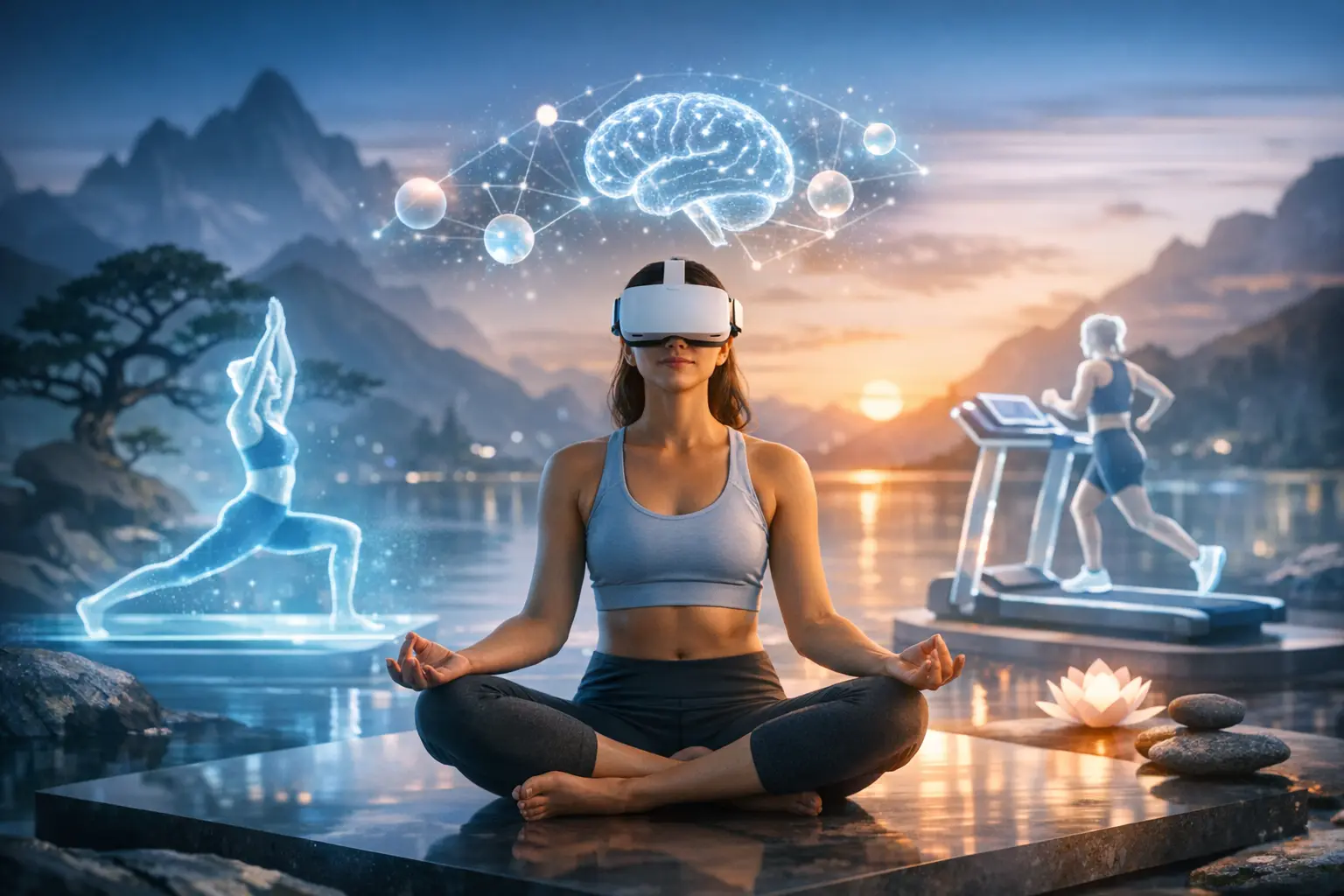
The metaverse and virtual reality are no longer niche tech curiosities—they’re becoming legitimate wellness environments where people meditate, move, socialize, and even receive therapeutic support. Done well, immersive wellness can reduce friction, make healthy habits more engaging, and deliver experiences that are hard to replicate in the physical world. The question is no longer whether VR can support wellbeing, but how to use it safely, effectively, and sustainably.
The Evolution of Wellness in the Digital Age: Understanding the Metaverse and VR
Wellness has always followed culture and technology. We moved from community-based health rituals to gym memberships, then to apps that track sleep, steps, and stress. Today, the next shift is immersion: instead of looking at a screen, you enter an environment designed to change how your body and mind feel in real time.
To make smart decisions about “metaverse wellness,” it helps to clarify terms. Virtual reality (VR) typically means wearing a headset that replaces the outside world with a fully digital space. Augmented reality (AR) overlays digital elements onto your real surroundings. The “metaverse” is broader: a network of persistent, shared digital worlds where you can interact with others through avatars, virtual objects, and connected services. In practice, metaverse wellness might happen in VR chat spaces, dedicated wellness platforms, fitness worlds, or blended experiences that connect mobile, PC, and headset users.
Why does this matter for wellbeing? Because immersion changes the levers you can pull. Traditional digital wellness relies on reminders and willpower: a notification tells you to breathe, and you choose to comply. In immersive wellness, your environment can guide behavior by design. Lighting shifts to cue relaxation. Soundscapes regulate tempo. Visual focus narrows physiological arousal. A virtual coach demonstrates movement from angles you can’t see in a mirror. Social presence makes you show up, even when motivation is low.
There’s also a psychological distinction: VR doesn’t just “inform” you; it can induce state change. Humans respond to perceived environments. When your brain interprets a place as safe and calming, the body can downshift. When it interprets a place as energizing and social, you may feel more activated and engaged. This is the core mechanism behind VR wellness: controlled context.
Of course, not all experiences deserve the wellness label. A loud virtual nightclub is a metaverse experience, but it may not support health goals. High-quality VR wellness is intentional about outcomes—stress reduction, consistent movement, recovery, social connection, habit formation—and it respects the user’s limits. That combination is what turns novelty into a meaningful practice.
As we move into therapeutic and habit-building use cases, the key question becomes: what can VR do that other formats struggle to deliver?
Exploring the Therapeutic Potential of Virtual Reality Environments
Therapy is fundamentally about learning—learning emotional regulation, new beliefs, new responses, and new skills. VR is unusually well-suited to skill learning because it can simulate contexts that trigger real reactions in a controlled, repeatable way. This is why exposure-based methods—used for phobias, social anxiety, and trauma-related triggers—have long been associated with VR. But the therapeutic potential goes well beyond exposure.
Consider the building blocks of many evidence-based therapies:
Attention control: The ability to focus, shift, and sustain attention is central to reducing rumination and anxiety. VR can train attention by giving you a simple task in a distraction-managed space—like following breath visuals, tracking a moving object, or practicing “notice and return” without competing notifications.
Physiological regulation: Stress is not just a thought; it’s a body state involving the autonomic nervous system. VR environments can help users practice downregulation through paced breathing, guided relaxation, and biofeedback. When paired with heart-rate sensors, a scene might brighten as your breathing slows, making the regulation loop visible and reinforcing.
Behavioral activation: Depression often reduces activity and social interaction. VR can lower the activation threshold by making movement and engagement easier to start. A five-minute “walk” through a calming forest, a gentle stretch class with others, or a short game-like workout can help users re-enter routines when the real world feels overwhelming.
Cognitive reframing and perspective-taking: VR can externalize thoughts—turning worries into objects you can observe, label, and “set down.” Some experiences use narrative and perspective shifts to support meaning-making and resilience. While this isn’t a replacement for therapy, it can be a powerful adjunct for practicing skills between sessions.
What makes VR therapeutically interesting is the combination of safety and realism. You can approach hard experiences gradually, with control over intensity. You can pause. You can repeat. You can practice coping skills in a context that feels “real enough” to evoke a response, but safe enough to learn from it.
Real-world applications are already taking shape:
Stress reset rooms in corporate settings where employees can do 7–10 minutes of guided breathing or a short nature immersion between intense tasks.
Pain distraction programs in clinical environments, where immersive attention reduces perceived pain intensity during procedures or rehabilitation. The principle is straightforward: attention is finite, and immersive environments can redirect it.
Social skills rehearsal for people who struggle with social confidence—practicing small talk, presentations, or boundary-setting in controlled virtual scenarios.
Still, therapeutic VR isn’t magic. The most common failure mode is treating VR as a one-off experience rather than a structured protocol. If the goal is anxiety reduction, the user needs a plan: frequency, duration, progression, and reflection. Another failure mode is ignoring individual differences. Some people find headsets disorienting. Others may experience derealization, heightened anxiety, or discomfort in certain scenarios. “Immersion” is a tool; the dose matters.
If therapy is the deeper end of the pool, wellness habits are where most people will start. And within wellness habits, two pillars dominate: mindfulness and fitness.
Integrating Mindfulness and Fitness: Strategies for Wellness in the Metaverse
Most wellness tools fail for practical reasons: they demand time, attention, and motivation at the exact moment you have the least of all three. The metaverse offers a different approach: design an environment so engaging—and so frictionless—that the healthy choice becomes the easiest choice.
To do that, you need strategy, not just a headset.
1) Build a “minimum viable routine” for consistency
If you’re trying to establish a sustainable practice, start with sessions short enough that you can’t talk yourself out of them. Five to ten minutes is often the sweet spot.
Example routine:
3 minutes of guided breathing in a calming environment (beach, forest, minimal visual clutter).
5 minutes of mobility (neck, shoulders, hips) with a virtual coach or mirrored avatar cues.
2 minutes of quiet cooldown—no instructions, just stillness.
This is not a “full program.” It’s a consistency engine. Once it’s automatic, you can layer intensity.
2) Use environment design to support the state you want
Mindfulness is not just mental; it’s sensory. In VR you can tune sensory input with precision.
If your goal is calm, choose experiences with:
Slow visual motion (or none).
Low-contrast lighting and soft edges.
Stable horizons (reduces discomfort and helps orientation).
Minimal surprise sounds.
If your goal is energy and movement, choose:
Clear rhythm and beat-driven cues.
High visibility of targets (better movement accuracy).
Immediate performance feedback (keeps motivation up).
3) Blend mindfulness into movement rather than treating them as separate
Many people think mindfulness means sitting still. In practice, mindful movement is often more accessible, especially for restless minds.
Try this approach inside VR fitness:
Before the workout: 60 seconds of “arrive” breathing—inhale for a count of four, exhale for a count of six.
During the workout: set one attentional anchor (for example, feel your feet on the ground or track the rhythm of your breath between sets).
After the workout: 60–120 seconds of downshift breathing, letting your nervous system return to baseline.
This turns exercise into regulation training, not just calorie burn.
4) Choose the right feedback: not too much, not too little
Feedback is motivating, but it can also create pressure. Some users thrive on performance metrics. Others experience anxiety when results are constantly displayed.
Actionable tip: If you notice perfectionism creeping in, turn off public leaderboards, hide calorie counts, and prioritize “time spent” or “sessions completed.” If you find yourself drifting, add one metric that matters—heart rate zone, session streaks, or movement accuracy—and review weekly, not daily.
5) Leverage social presence carefully
Group classes, virtual running clubs, and shared meditation rooms can increase adherence dramatically. Social accountability is powerful because it’s emotional, not logical.
But it’s a double-edged sword. Social comparison can undermine wellbeing, especially in body-image-sensitive contexts. Choose communities with clear norms: supportive language, no harassment tolerance, and instructors who cue self-pacing. If you’re new, start with small groups or instructor-led sessions before jumping into large public spaces.
6) Make your physical space “VR-safe” for fitness
It sounds basic, but it’s essential. Metaverse wellness fails instantly if it causes injury.
Use a clear space with no low tables, pets, or loose objects.
Set boundary systems properly.
Wear shoes for high-intensity sessions if your surface is slippery.
Use a fan to reduce overheating and motion discomfort.
The more seamlessly mindfulness and fitness work together, the more VR becomes a true wellness platform rather than an occasional novelty. Yet, the deeper promise—using immersion to address mental health barriers—requires careful, ethical design and self-awareness.
Overcoming Barriers: Addressing Mental Health Challenges through Immersive Experiences
One of the most compelling uses of immersive wellness is lowering barriers to care. Many people don’t avoid help because they don’t want it; they avoid it because of stigma, scheduling, cost, transportation, or the emotional burden of showing up in person when they already feel depleted. VR can remove some of that friction—but it can also introduce new risks if used carelessly.
Barrier: “I can’t get myself to start.”
When someone is anxious or depressed, even small tasks can feel huge. VR can help by compressing the steps between intention and action. Put on the headset, and you’re already “there.” No commute. No awkward waiting room. No decision fatigue about what to do next.
Practical tactic: Create a one-click launch path. Pin one calming experience and one movement experience to your home screen. Don’t browse. Browsing increases avoidance.
Barrier: “I don’t feel safe or comfortable in public spaces.”
For people with social anxiety, trauma histories, or neurodivergent sensory sensitivities, real-world wellness spaces can be overwhelming. VR can provide controlled privacy while still offering guided support.
Practical tactic: Start with private sessions, then move to small, moderated groups. Gradual exposure—when done intentionally—builds tolerance without flooding.
Barrier: “My mind won’t shut off.”
Traditional meditation is hard when intrusive thoughts are loud. VR can reduce wandering by giving the mind a gentle focus—like a breathing orb, guided visuals, or interactive relaxation. This is not “cheating.” It’s scaffolding. Over time, users often need less guidance as attentional control improves.
Barrier: “I don’t relate to typical wellness culture.”
Some people bounce off conventional wellness aesthetics. Immersive environments can personalize tone, identity, and context. Want a sci-fi dojo instead of a yoga studio? A mountaintop at dusk instead of a bright gym? Personal resonance improves adherence, and adherence matters more than perfection.
That said, mental health support requires mature guardrails.
1) Avoid replacing human care when human care is needed
VR wellness can support coping and skills practice, but it should not be positioned as a substitute for professional treatment for severe depression, active suicidality, psychosis, or complex trauma without qualified oversight. Immersive experiences can intensify emotions. Anyone with significant symptoms should have access to real-world support and a plan for escalation.
2) Watch for dissociation and “escape spirals”
Immersion can be soothing, but it can also become avoidance—especially if VR is used to escape daily responsibilities, relationships, or difficult emotions rather than process them.
Healthy use looks like: you feel better regulated, you re-engage with life, and your functioning improves.
Unhealthy use looks like: longer sessions over time, reduced real-world engagement, irritability when not in VR, or using VR exclusively to numb out.
Actionable self-check: After a session, ask, “What is one real-world action I can take now?” If the answer is always “go back in,” it’s time to rebalance.
3) Prioritize privacy and psychological safety
Wellness data is sensitive: voice, movement patterns, biometrics, and emotional disclosures. In social metaverse spaces, harassment and boundary violations are real risks.
Practical safeguards:
Use platforms with clear moderation tools (mute, block, personal space boundaries).
Review privacy settings and limit data sharing.
Avoid discussing deeply identifying personal details in large public rooms.
4) Reduce cybersickness and sensory overload
Discomfort undermines wellbeing quickly. Cybersickness is often triggered by visual motion that doesn’t match body motion. New users should favor stable environments, teleport movement, and shorter sessions. If someone is already anxious, nausea can amplify panic—so ramp slowly.
When thoughtfully designed, immersive wellness can meet people where they are: anxious at home, lonely on a Sunday evening, or struggling to restart exercise after burnout. And as hardware and software mature, the next wave will expand what “wellness” can even mean.
The Future of Health and Wellbeing: Innovations and Trends in Metaverse Wellness Solutions
The next generation of metaverse wellness won’t be defined by prettier graphics. It will be defined by precision, personalization, and integration—turning immersive experiences into coherent health systems rather than isolated apps.
1) Biofeedback-driven experiences will become mainstream
As wearables and headset sensors improve, VR environments will respond to your physiology in real time. Imagine a meditation where the environment changes based on heart-rate variability, not button presses. Or a recovery session that adjusts breathing pace dynamically as your body settles.
Why this matters: biofeedback turns subjective states into trainable skills. You learn what calm feels like, what triggers you, and what reliably brings you back to baseline.
2) Adaptive coaching with safer personalization
Wellness coaching often fails because it’s generic. Future systems will adapt to your movement patterns, mobility limitations, and fatigue signals. Fitness programs will adjust intensity based on form quality and recovery, not just “level.” Mindfulness programs will shift between guided, semi-guided, and silent modes as your consistency improves.
The most effective personalization will be subtle: fewer choices, better defaults, and a clear path that reduces decision fatigue.
3) Therapeutic “digital clinics” inside VR
We’ll likely see more clinician-guided programs delivered partly in immersive space: group coping-skills classes, exposure protocols, stress-management training, and rehabilitation programs run by licensed professionals. The advantage is scale and access—especially for people in rural areas or those with mobility constraints—while keeping clinical governance intact.
4) Social wellness will mature beyond “classes”
Human connection is a health variable. Expect more structured social designs: peer support circles with moderation, goal-based micro-communities, and cooperative experiences that build belonging without relying on performative social media mechanics.
Look for platforms that reward pro-social behavior (encouragement, consistency, mentoring) rather than only performance and aesthetics.
5) Digital twins and blended reality routines
The most sustainable metaverse wellness will not trap you in a headset. It will connect to real life. A “blended routine” might look like:
Morning: 5 minutes of VR breathwork to set baseline calm.
Midday: a real-world walk tracked by a wearable.
Evening: a VR mobility session that references your step count and tightness points.
This is where the metaverse becomes a layer in a larger health loop—supporting, not replacing, the physical world.
6) Ethics, accessibility, and safety will become differentiators
As adoption grows, expect clearer standards around:
Age-appropriate design and time limits.
Data privacy, biometric protection, and consent.
Accessibility for users with disabilities (seated modes, captioning, motion adjustments).
Harassment prevention and identity safety in social wellness spaces.
In wellness, trust is part of the product. The platforms that treat safety as core infrastructure—not a checkbox—will earn long-term loyalty.
So what should you do now, before the future fully arrives? Start with intentional use. Choose one outcome you care about: calmer evenings, consistent movement, better recovery, less social isolation. Pick one or two high-quality experiences that match that outcome. Track how you feel and function over two weeks. Adjust the dose. Keep what works.
Conclusion
Metaverse and VR wellness are best understood as tools for state change, habit formation, and supported practice—not as escapist replacements for real life. Immersive environments can make calming down easier, moving more engaging, and therapeutic skills more repeatable by placing you inside a designed context rather than asking you to force focus on a flat screen.
The opportunity is real, but so are the responsibilities: choosing experiences that match your goals, protecting privacy, pacing intensity, and knowing when to involve qualified human support. If you approach VR wellness with the same discipline you’d bring to training or therapy—clear outcomes, sensible routines, and honest self-checks—it can become one of the most practical and motivating health tools of the digital age.